
Manipur needs an integrated politico, military, socio-economic approach, says Sanjeev Nayyar.
'An event that should have made India proud was being perceived entirely as a money-making enterprise, resting on malpractices and without any benefits whatsoever for the Capital and its people.'
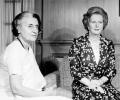
Former Prime Minister Indira Gandhi wrote a personal letter to her British counterpart Margaret Thatcher soon after the 1984 Operation Bluestar in an attempt to justify her decision to send army to flush out militants from the Golden Temple, the holiest Sikh shrine.

Rangoon haunts in unlikely fashion and, while the director's most straightforward picture, holds enough of its own marvels to justify multiple viewings,' notes Raja Sen.

How China's all powerful Communist party bungled the response to the coronavirus crisis.
'I will need a few more pictures, sir, can I get some time from you for a more extended photo shoot?' asked Singh. Modi, ever-obliging before the camera, laughed. 'Sure, but let us plan to do it after my swearing-in is over in May!' The Balakot effect was evident. A fascinating excerpt from Rajdeep Sardesai's 2019: How Modi Won India.

'If you destroy the assets in Pathankot, you degrade the combat potential of India; you degrade the war potential of India.'

The paramilitary and police forces in the country have lost 31,895 personnel in the last 53 years in the line of duty but they are still fighting for the "martyr" status for the dead officers and men like in the armed forces.

'The Andaman and Nicobar Islands are an asset that any country aspiring to become a major power would give anything to own.' 'It is disappointing that India has not capitalised on this potential,' says Vice Admiral Premvir Das (retd).
'According national security and higher defence management empathetic political attention they warrant is critical. Will Prime Minister Modi pick up this gauntlet?' asks C Uday Bhaskar.

The three-page guidelines, issued by the home ministry recently and notified to Central Armed Police Forces headquarters in New Delhi, speak specifically of instances where force personnel have used personal cell phones to click pictures of an ongoing or concluded ambush or operation

Gurmeet Ram Rahim also made an appeal to his followers to go back to their homes, a development which may come as a big relief to security personnel.

Lance Naik Mohan Nath Goswami met a hero's end battling Lashkar-e-Tayiba terrorists in the jungles of Kashmir. His valour earned him the nation's highest gallantry award in peacetime this Republic Day. Archana Masih/Rediff.com travelled to Lal Kuan, Haldwani, to find out who this hero was.
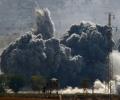
Egypt launched air strikes in Libya, in an escalation of Egypt's battle against IS' growing militancy

'Pakistan's military leaders have to accept that the policy of proxy wars has damaged Pakistan more than it has damaged the enemy,' says former R&AW chief Vikram Sood.

Banned outfit Communist Party of India-Maoist Tuesday claimed responsibility for the massacre of Congress leaders in Bastar region and demanded immediate suspension of all operations against it across the country.

The year is coming to an end and overall, it's been one hell of a year! We have had our share of ups and downs and we look forward to a better 2020. While we count down the days to the new year, let's also reflect on those who gave us strength to stand up in what we believe, the courageous who didn't bow down and the ones with gumption who inspired us to be better. We, Rediff.com, have selected 26 personalities, who we think are worthy of the title -- HERO OF THE YEAR -- and we want you, dear readers, to choose your hero!

The Afghan deputy foreign minister explains how his nation's President became disillusioned with Pakistan. Ajai Shukla listens in.

'Captain Haneef-ud-din, pulling his sinewy body forward, crawled, rifle in hand, in the snow on 6 June 1999. He died on this craggy mountainside exactly two years after he had passed out of the IMA...'

As Cyclone Hudhud is closing in on the Andhra Pradesh coastline and is expected to make a landfall near Visakhapatnam by Sunday afternoon, about 1.11 lakh people in five coastal districts have been shifted to safer places.

Indian intelligence agencies have often claimed that left-wing extremists are trying to make inroads in the militancy-hit regions of north-east to foment further unrest. But Jaideep Saikia, noted terrorism and conflict analyst, claims, "People who speak of Maoism taking roots in the north-east have not read history".
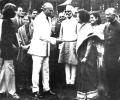
'Indira Gandhi, it appears, did not to consult her Cabinet colleagues, or diplomats, or civil servants when she decided to sign the agreement in Shimla.' 'We ruefully recall Bhutto's perfidy and the Indian prime minister's gullibility,' says Lieutenant General Ashok Joshi (retd).

On display was India's military might and cultural diversity.

'Buddy knows more about Raju's films because he sits in the editing room.' 'He has seen Sanju a number of times already!'

Pakistan-based Lashkar-e-Tayiba's technology chief had posed as an Indian businessman while negotiating to buy from an American company a Voice-over-Internet Phone service that was later used by the LeT handlers to communicate with 26/11 attackers while concealing their actual origin.

'This is a movie made with this gaze fixed on its immediate well-wishers, while at the same time it squints hard looking for those swaying back and forth on the fence,' notes Rohit Sathish Nair.

'She was the only prime minister who won a decisive military victory.' 'She won a real war; she didn't play video games on prime time TV over surgical strikes!' 'She understood power better than any other politician, saw it as her birthright and used it with inborn expertise.' 'Every politician today who tries to be a "supremo" through populism and absolute control over his or her party is referring to the Indira Gandhi playbook!'

India is no longer shying away from playing a role on the regional and international stages and is willing to don a bigger role in regional politics. It is showing traits of a responsible stakeholder in the regional security dynamics, says Dr Rahul Mishra.
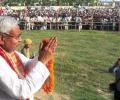
The Bharatiya Janata Party claims it has over six lakh committed workers in Bihar, a team of 10 deployed for each of the 62,200 polling booths.

India needs to be alert on how the Doklam standoff plays into the factional infighting in China's Communist Party, says Ambassador Shyam Saran, the former foreign secretary.

'The Chinese mindset and approach to India is far different from that in Pakistan.' 'This reality makes it possible for us to follow an engagement policy with one, while militating against engagement with the other.'
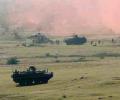
Powerful senators write to US Defense Secretary Hagel to support a robust defence relationship with India to achieve shared goals and form an unwavering bond between the world's two largest democracies. Aziz Haniffa in Washington, DC
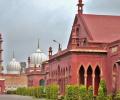
'AMU is a secular university with an Islamic ethos.' 'We do not discriminate on the basis of religion. Let me tell you Muslims do not need reservations. They need affirmative action in education.'

The Border Defence Cooperation Agreement with China needs closer scrutiny, says Rup Narayan Das.

More than 60 years ago, a bicycle thief in Louisville, Kentucky, unknowingly set in motion one of the most amazing sports careers in history.

Terror operative Abu Jundal's trial on December 9 is likely to open a new war of words, for his claims on another LeT operative Sajid Mir, who, Jundal has claimed that was a 'khaas aadmi' of the ISI. Vicky Nanjappa reports

How did Mansoor Peerbhoy, an academically bright, suave and soft-spoken young man, who never exhibited any jihadist tendencies, go on to head the Indian Mujahideen's media cell?

One of the most sought after exhibitions in Asia, as many as 549 companies are participating this year with 53 fighter aircraft on display.

Hein Kiessling has the kind of access in Pakistan that journalists (and spies) would die for, says Kanika Datta.

'Patel was more in tune with the popular mood than Jawaharlal Nehru. While the principle that Hindus and Muslims should be able to live together remained central to Nehru's vision for India, the Sardar was less sentimental.' 'Nehru would angrily face down mobs himself, rushing from trouble spot to trouble spot. A veritable tent city, filled with Muslim refugees, sprouted on the lawns of his bungalow... Mountbatten feared Nehru's impulsiveness would get him killed, and assigned soldiers to watch over him.' Nisid Hajari's Midnight's Furies: The Deadly Legacy of India's Partition casts fresh light on the events and personalities behind the horrific division of the subcontinent which haunts the India and Pakistan to this day.
 © 2026 Rediff.com - Advertise with us - Disclaimer - Privacy Policy - Sitemap - Feedback - About us - Terms of use - Grievances